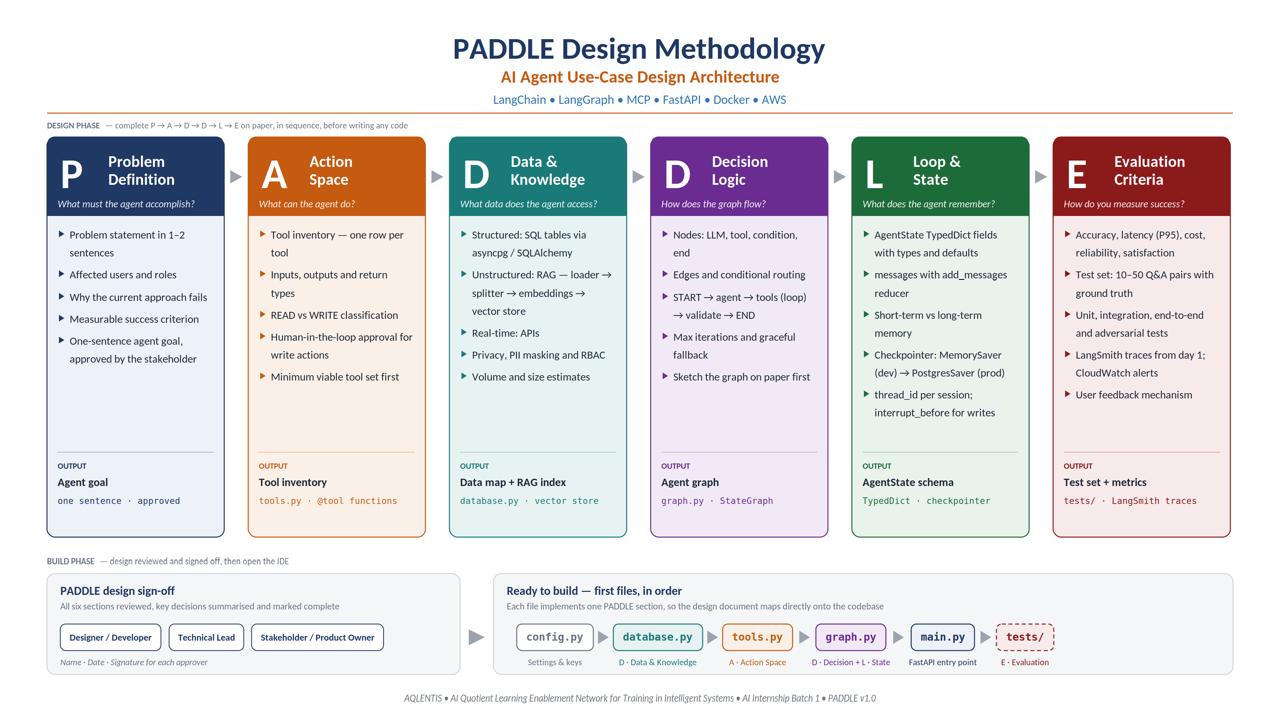
Design phase → build phase
PADDLE Design Methodology
AI Agent Use-Case Design Architecture
Complete P → A → D → D → L → E on paper, in sequence, before writing any code. Each section becomes one file in the codebase, so the design document maps directly onto what gets built. LangChain · LangGraph · MCP · FastAPI · Docker · AWS.
Problem Definition
What must the agent accomplish?
- Problem statement in 1–2 sentences
- Affected users and roles
- Why the current approach fails
- Measurable success criterion
- One-sentence agent goal, approved by the stakeholder
Output
Agent goal
one sentence · approved
Action Space
What can the agent do?
- Tool inventory — one row per tool
- Inputs, outputs and return types
- READ vs WRITE classification
- Human-in-the-loop approval for write actions
- Minimum viable tool set first
Output
Tool inventory
tools.py · @tool functions
Data & Knowledge
What data does the agent access?
- Structured: SQL tables via asyncpg / SQLAlchemy
- Unstructured: RAG — loader → splitter → embeddings → vector store
- Real-time: APIs
- Privacy, PII masking and RBAC
- Volume and size estimates
Output
Data map + RAG index
database.py · vector store
Decision Logic
How does the graph flow?
- Nodes: LLM, tool, condition, end
- Edges and conditional routing
- START → agent → tools (loop) → validate → END
- Max iterations and graceful fallback
- Sketch the graph on paper first
Output
Agent graph
graph.py · StateGraph
Loop & State
What does the agent remember?
- AgentState TypedDict fields with types and defaults
- messages with add_messages reducer
- Short-term vs long-term memory
- Checkpointer: MemorySaver (dev) → PostgresSaver (prod)
- thread_id per session; interrupt_before for writes
Output
AgentState schema
TypedDict · checkpointer
Evaluation Criteria
How do you measure success?
- Accuracy, latency (P95), cost, reliability, satisfaction
- Test set: 10–50 Q&A pairs with ground truth
- Unit, integration, end-to-end and adversarial tests
- LangSmith traces from day 1; CloudWatch alerts
- User feedback mechanism
Output
Test set + metrics
tests/ · LangSmith traces
Annex A (v1.1)
Scalability, LLM cost & hosting
Your design is reviewed on whether the agent can actually be operated, not just demonstrated in a notebook. Show the assumption and the formula behind every number; take token counts from real LangSmith traces.
- A1 — Expected load
- A2 — LLM cost estimate: (input × price + output × price) ÷ 1,000,000
- A3 — Hosting estimate, component by component
- A4 — Scalability plan and the single biggest bottleneck
- A5 — Deployment plan: Docker → CI → environments → secrets → rollback
Review
How your design is scored
Every section is scored 0–5. Progress = checklist items ticked ÷ 39. Quality = total section score ÷ 35. A section scores at most 2 if any hint text is left unreplaced.
1. Progress
Sections completed and checklists ticked (39 items).
2. Strong areas
What is well designed and should be kept.
3. Weak points
Vague, missing, inconsistent or unrealistic items.
4. Agent performance
Accuracy, latency, reliability targets, test set and safety limits (Section E).
5. Product scalability
Can the design go from 10 to 1,000 users without a rewrite (Annex A).
6. Cost
LLM cost per request and per month, plus hosting cost (Annex A).
Verdicts: Approved · Approved with changes · Revise and resubmit · Rework scope.
Build phase
Ready to build — first files, in order
Design reviewed and signed off by Designer/Developer, Technical Lead and Stakeholder — then open the IDE.
config.py
Settings & keys
database.py
D · Data & Knowledge
tools.py
A · Action Space
graph.py
D · Decision + L · State
main.py
FastAPI entry point
tests/
E · Evaluation
Templates & documents
- PADDLE Use-Case Template (PDF)17-page design template, v1.0
- PADDLE Use-Case Template — Fillable (DOCX)Type straight into it, v1.1 with Annex A
- PADDLE Architecture one-pager (PDF)Design phase → build phase on one page
- PADDLE Review Scorecard (DOCX)For team leads and instructors
File name for submissions: PADDLE_<YourName>_<AgentName>_v1.docx